Carole Brooks Platt, Ph.D.


Carole regularly attends the Science of Consciousness Conference in Tucson, AZ, except 2020, the year of the coronavirus. She has presented her research there, as well as at poetry events and other academic settings.


Her work was originally informed by Julian Jaynes's theory on the hallucinatory origins of poetry and prophecy in the right hemisphere of the brain.


She was an invited speaker at the Julian Jaynes Conference in Charleston, WV, in 2013, and, more recently, at a symposium on "Further Reaches of the Imagination II" at the Esalen Center for Research and Theory in Big Sur, CA, Nov 1-6, 2015. She was also invited to speak at the Poetry by the Sea global conference in Madison, CT, May 2016, but, unfortunately, was unable to attend.

On February 23, 2017, she presented her research at the Jung Center of Houston.


Her book, In Their Right Minds: The Lives and Shared Practices of Poetic Geniuses, brings together all of her literary and neuroscientific research and was an Amazon Hot New Release in Neuropsychology and Poetry / Literary Criticism.


Carole also provides research on hemispheric differences, atypical lateralization, and handedness at:

https://www.facebook.com/RightMindMatters/.


Carole is currently working on a book on female mystics and mediums, beginning with Joan of Arc, and female poets who felt aligned with Joan. Carole's popular stand alone article on Joan of Arc is available for purchase from her publisher:


https://www.ingentaconnect.com/content/imp/jcs/2019/00000026/f0020011/art00008

Showing posts with label Allan Schore. Show all posts

Seeing the Light, Speaking like a Poet: Alain Forget and Other Mystical Experiencers


At the 2016 Science of Consciousness Conference in Tucson, AZ, I saw a presentation by Dr. Peter Fenwick, an NDE researcher at Cambridge. Dr. Fenwick had been studying the French mystic, Alain Forget. Fenwick had filmed observable globules of light floating around a room, as Forget taught meditation to his students. As I said in my last post, light phenomena are known to be associated with both death and mystical experiences. Forget, however,  has the ability to give light to his students, who report feeling an energy opening their hearts, according to Fenwick.

Hyperscanning of Forget’s brain and a student showed very high gamma waves in the left posterior area of the brain and beta waves spreading out from the temporal lobes.  High gamma indicates heightened perception and beta indicates normal awake alertness. Fenwick said Forget was clearly driving the student’s brain with his own. However, if Forget wore goggles, the light connection failed, showing the effect had something to do with his eyes.
Fenwick is not alone in his endeavor to understand light phenomena. After the presentation, a young researcher from neuroscientist Michael Persinger’s Canadian lab came to the microphone. She said her boss was doing studies on light transfer as well. An Indian man also came forward, claiming such non-local events can be produced even at great physical distances.

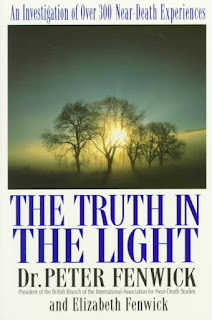
In 1996, Dr. Fenwick wrote a book, The Truth in the Light, about people being enveloped in light and seeing beautiful colors, encountering a presence, hearing a voice, or encountering visible “spirits” during Near Death Experiences (NDEs). During his Tucson presentation, he claimed experiencers have no privileged age range; religious belief is not important; they see beautiful landscapes and hear heavenly music with high “emotional quality” showing “strong involvement of the right hemisphere.” NDErs mostly see relatives, even if they didn’t know they were dead, and always in their prime. Sometimes, a “Being of Light” sends the experiencer back to life careening through a tunnel.

Fenwick mentioned that Forget had written a book, How to Get Out of This World Alive, which I have now read. Fenwick says in his foreword: “Alain Forget is one of the leaders of a new wave of philosophers who, through working on themselves, using the tools bequeathed to us by the ancient Masters, have achieved a breakthrough in his experience of consciousness (14).” You can see Forget being interviewed by the patient and curious Iain McVay on Conscious.tv. Forget presents as a quite self-assured individual who has studied with great masters and read the works of mystics past.

Forget had his first mystical experience as a young man of 25 while sitting in Chartres Cathedral. Going to sacred places to read metaphysical texts and meditate silently was his practice. On this occasion, awakened by the notion that he was not his thoughts or emotions, Forget became “one with life and free of fear.” He claimed, in a Jungian way, he had dismantled his shadow and opened up his soul. With thought and desires gone, light appeared. He could now help others attain “a state of consciousness that transcends time and space and transmit energy that has a power to accelerate their evolution (17).” Another mystical event at 39 removed all thought and further awakened him to the need to drill into his/our repressed layers and develop a body of energy, that is, of light. Forget claimed he could turn his energetic state on or off at will to operate in the world.

Coincident with my study on  poets, Evelyn Underhill, in her 1911 classic, Mysticism: A Study in the Nature and Development of Spiritual Consciousness, claimed that visionaries, poets and saints find the “reality behind the veil (4).” This singular reality is Absolute: senses are “fused into a single and ineffable act of perception, and colour and sound are known as aspects of one thing (7).” By altering their consciousness, they “apprehend a deeper reality . . . unrelated to human speech,” which can only be expressed as poetry (31).  “‘How glorious,’ says the Voice of the Eternal to St. Catherine of Siena, ‘is that soul which has indeed been able to pass from the stormy ocean to Me, the Sea Pacific, and in that Sea, which is Myself, to fill the pitcher of her heart (37).’” Underhill showed that with light and heart entwined, union with “the One” becomes an “ineffable illumination of pure love (41).” St. Augustine too saw “the light that never changes” with the “mysterious eye of the soul,” as “primarily a movement of the heart.”

Here, Underhill is particularly clear about the unconscious aspect of creativity:

In the poet, the musician, the great mathematician or inventor, powers lying below the threshold, and hardly controllable by their owner’s conscious will, clearly take a major part in the business of perception and conception. In all creative acts, the larger share of the work is done subconsciously: its emergence is in a sense automatic. This is equally true of mystics, artists, philosophers, discoverers, and rulers of men. The great religion, invention, work of art, always owes inception to some sudden uprush of intuitions or ideas for which the superficial self cannot account . . . this is ‘inspiration’; the opening of the sluices, so that those waters of truth in which all life is bathed may rise to the level of consciousness . . . behind the world of sense (63).

She was also very poetic herself:

“[The self] has, it seems, certain tentacles which, once she learns to uncurl them, will stretch sensitive fingers far beyond that limiting envelope in which her normal consciousness is contained, and give her news of a higher reality than that which can be deduced from the reports of the senses. The fully developed and completely conscious human soul can open as an anemone does, and know the ocean in which she is bathed. This act, this condition of consciousness, in which barriers are obliterated, the Absolute flows in on us, and we, rushing out to its embrace, “find and feel the Infinite above all reason and above all knowledge,” is the true “mystical state (51).”


Underhill says mysticism is a dissociative state of consciousness that can be attained through self-hypnosis, dancing, music or other exaggerations of natural rhythm, as Persinger has suggested. It can also happen inadvertently, as I  experienced myself on one wonderful day in San Antonio, TX. With thought gone and and all of my senses titillated at once, I took a brief dip into the borderless bliss of Nirvana.


But, as with poets, mystics did not always experience bliss. Sometimes they were plunged into the so-called “dark night of the soul.” In both cases this would seem to indicate bipolar disorder, with a switch between negative right and positive left voices and visions, sometimes accompanied by a sudden inability to read (393). Some mystics, like Joan of Arc or Muhammad, were not literate from the start. It seems that the inability to read or write may open a space in heart and mind for intuitions of genius to enter unheralded as voices from a "holy" Other, especially in a solitary environment accompanied by deprivations.

Underhill’s female saints often used food deprivation to attain ecstatic states. Mechthild of Magdeburg, a 13th century saint who wrote "The Flaming Light of the Godhead," and Catherine of Siena, whose only food was the communion host, are two examples. Beyond starvation, Underhill emphasized that "reality present[ed] itself to them under abnormal conditions . . . [t]hanks to their peculiar mental make up," citing Mme Guyon and St. Teresa along with William Blake in 'Milton' and 'Jerusalem.'" The very tenor and tone of mystical language, she added, "no less than musical and poetic perception, tends naturally . . . to present itself in rhythmical periods: a feature which is also strongly marked in writings obtained in the automatic state (80)." Mystics must have "a nervous organization of the artistic type (91)." She also identified their ability to feel a sense of presence long before Michael Persinger’s studies (242). Finally, "Over and over again they return to light-imagery (249)."


In my book, I call this "nervous organization" an enhanced right hemisphere, where language is either right dominant or bilateral, regardless of handedness. Illumination, so-called because mystical knowledge and light come to the fore, occurs following synchronization of the hemispheres and may involve a sense of presence. St. Teresa sensed the presence of Jesus on her right side, but saw a vision of a small male angel on her left side, who thrust a long spear of gold into her heart and entrails, leaving her "on fire with a great love of God (295)." The left hemisphere offered the image of Jesus, while the angel from the right tortured her into ecstasy.

In both poets and mystics, we see a common thread: early childhood trauma, atypical lateralization, voracious reading habits in search of high significance, deprivations, difficulties, mental exhaustion, with verbal expression sometimes produced in dissociative states of consciousness. Alain Forget, despite his assured countenance, is no exception. He was an only child who lost his mother at 18 months and his father at 9 years old. Watching him speak in the interview, we see him favoring his left hand, then his right, but mostly using both at once. He has a long straight brow line more to the left, showing enhanced right dominance. His ease of entering mystical states is in itself a prime qualification for an atypical mind.

Why does Forget call his book, How to Get Out of This Life Alive? He says from the very start that “As long as there is death, there is fear. / Only victory over death will make fear die (3).” The method of attaining this victory is through the Four D’s: Distancing, Discernment, Disidentification and Discrimination. As Dr. Fenwick describes in his introduction to the book, the process requires a dismantling of the ego through attentiveness, introspection, letting go, and deep self-questioning. In Forget’s words, practicing the Four D’s allows you to transcend the world of  “polar opposites” (conscious/unconscious) to become pure consciousness (20).


Forget says our shadow begins with birth trauma, as we leave the undifferentiated state in the maternal womb. He adds on the negative effect of early traumatic experience on the developing brain, just as Allan N. Schore did in Affect Regulation and the Origin of the Self. As I found in my poets, loss of a parent, parental attachment issues and/or a genetic predisposition to emotional disorder can alter the brain. Dissociative selves arise from painful experiences. Forget claims that by overcompensating for pains inflicted, we trigger anxiety. What is his simple formula for overcoming the darkness? Focus on three separate sensory fields at once; for instance, feel your feet on the ground, listen to the sound of birds in the trees, and look at a tree to detach from fearful thoughts and feelings.

Forget also recommends 1) a regular practice of silence—30 minutes on an empty stomach each day; 2) balancing one’s masculine side (left brain) and feminine side (the creative and intuitive aspects of the right brain, as he puts it); 3) as you let go of anxiety,  you sense that psychological time is an illusion; bad behavior patterns dissolve and you now feel consciousness as energy (69). Letting go of the gods of yore, you can perceive them rather as quantum, magnetic, electromagnetic and electrochemical fields. Consciousness, he says, has now evolved into an energetic state.

“We are all a mixture of light and dark," he says (153). By dismantling the shadow, you “transmute it bit by bit into a body of light (145).” Can anyone develop a soul, a body of light? Categorically, no: 


“When you come into this world, you have the potential to crystallize a diamond to get out of it alive. It is up to you to develop it. If the day you die, this crystallisation has not gained sufficient substance, everything will dissolve in the collective unconscious. But when your soul reaches a certain power level, you leave the archetypes of this planet behind and your psychic destiny becomes cosmic (150).”


Hearing the Voice, Getting it Right


 Once, in a frightening dream, a patient on a psychiatrist’s couch shouted at me: “Freud only got it half right!” Following this ambiguous remark, the Darth Vader-like voice bellowed a command: “Read the two Hyperion poems!” After twenty years of research, I am now attempting to explain the neurological and psychological origins of the dissociative knowledge that has entered some of history's greatest poetic minds.


Victor Hugo once heard a voice declare “Au travail, grand homme!” His mind, altered by loss of a loved one and political exile, had transformed the sound of the waves crashing around his island home into a command to get to work. He spent two and a half years attempting to contact the dead during his exile, writing the immortal Les Misérables and reams of poetry as well. Soliciting the advice of the dead poets and prophets he had long admired helped him dull the pain of his diminished, alienated universe. Other great poets were also impelled by traumas and losses to explore similar means of consolation.


American poet James Merrill spent 20 years contacting the dead using a Ouija board with his companion David Jackson. The dissociative words, spelled out in haste and often with humor, described the history and invisible functioning of the universe that would be molded into Merrill's brilliant and self-consoling 560-page poem, The Changing Light at Sandover.


William Butler Yeats accessed voices through his wife, Georgie. She either spoke the words while asleep, as Yeats wrote them down, or produced automatic handwriting. Like Merrill with Jackson, Yeats would construct a grand scheme to order the universe, where he held an important position. Poet Rainer Maria Rilke’s voice came to him like Hugo's, transformed in the rush of wind and waves. Highly poetic and personal language poured forth, combating loss and entraining truth and beauty in its wake.


Neither poet nor prophet, I am just a scribe trying to get it right. I wish I could get the words from a Ouija board (much more convenient than Hugo’s laborious table tapping in family séances) or from an inspired rush of wind or waves titillating my mind in a self-hushed trance. Outside of my original dream message, I have never received any other dissociative knowledge. I have read the scientific literature and analyzed other's creative voices to make sense of the phenomenon.

In my doctoral days, I had studied how the mythic mother ruled in early human history; how she was dethroned by patriarchal forces; but also how she inevitably returns in times of crisis in the mythic undercurrents of literature, especially in poetry. Matriarchal myth studies subsided in the wake of the crisis experience of a close friend of mine. After her mother’s death, she claimed to hear the voices of angels advising and consoling her, helping her deal with life and grief as well as to become an intuitive healer. Her experience led me to the poets, as my dream "mad" man pointed the way.


The first book that helped me make sense of her experience was Julian Jaynes's, The Origins of Consciousness in the Breakdown of the Bicameral Mind (1976). Here, he located the voices of the gods in the right temporal lobe of the brain.  Due to migrations, historical catastrophes, and, especially, the beginning of literacy, the voices fell silent and self-consciousness was born. Mental “breakdowns” can return one to a “bicameral” or dissociative mind. Jaynes’s theory was compelling, yet 
controversial, and needed updating with current scientific research.


Jung also experienced voices and visions and used these perceptions to construct his account of individual psychic life and the connections that bind us all. A line in his biography Memories, Dreams, Reflections, in fact, eerily replicated my dream message: “Freud was only considering half of the whole.” Freud’s "half" theorized the sexually desired birth mother, while Jung’s "half" longed for the mythical Great Mother. Could it be both were right?

Jung’s work is enormously helpful in understanding the voices. Yet, modern neuroscience reaffirms Freud in the sense that the infantile relation to the mother can alter the brain, not through sexual longing but through psychic wounding. Since many neuroscientists now agree that the wounding occurs in the right hemisphere, perhaps by adding Freud's maternal half to Jung's mythic half we find our way to a deeper truth.


Tallying the mythic mothers, the mother-mediated crises, the voices of female angels and the poetic muses, I felt that everything was constellating around the mother, the original other who we were until we developed a separate consciousness. The mother mirrored the child, who internalized her presence until he or she could regulate their own emotions. Dr. Allan N. Schore’s book, Affect Regulation and the Origin of the Self,  identified and located this process in the right hemisphere. No longer a metaphorical construct, the feminine was literally hardwired into the child’s mind. Here, in the pre-verbal matrix of the emerging self, maternal wounds can scar a child. An abusive, neglectful, or lost mother, as well as a smothering one, could create problems of boundary loss or self-control issues so common in pathological disorders. Later crises, especially the death or loss of loved ones, can open old wounds.


Poetic words are an embodiment. Confronted with loss, abandonment, or fear of death, words may arise unbidden, seeking to construct a hierarchy to defend against that chaotic absence. The mind reels without an internal stabilizing principle. A void must be filled; order must be restored. An all-encompassing premise becomes a presence containing the grief and giving the injured self a larger, comforting space to inhabit—the one vacated by the mother.

The locus of that new ordering--the right temporal lobe--uses the raw materials of memory as well as snatches of bits from the natural world around it to create, much like in a dream. Its fears and preferred ways of making sense of the world will color its creations. The loss and the proclivities appeared again and again as I studied the minds of great poets who heard voices or used dissociative techniques to access them. Analyzing their ability to put their preoccupations into words tells us not only about the poetic process but also about ourselves—our common human psychology, our preoccupations and our ability to create.

This study sheds light on commonly observed phenomena, explained from the dual optic of neuropsychology and poetry. Why does a disordered sense of self so often result in conflicted impressions of gender? Why does the disordered self so often use religious or mythic imagery? Why does religion itself so often constellate around gender issues and death? Sorting through the evidence that neuroscience and the poets provide, my book, In Their Right Minds: The Lives and Shared Practices of Poetic Geniuses, attempts to make sense of it all, while fully appreciating the great mystery and beauty of the creating mind.