Carole Brooks Platt, Ph.D.


Carole regularly attends the Science of Consciousness Conference in Tucson, AZ, except 2020, the year of the coronavirus. She has presented her research there, as well as at poetry events and other academic settings.


Her work was originally informed by Julian Jaynes's theory on the hallucinatory origins of poetry and prophecy in the right hemisphere of the brain.


She was an invited speaker at the Julian Jaynes Conference in Charleston, WV, in 2013, and, more recently, at a symposium on "Further Reaches of the Imagination II" at the Esalen Center for Research and Theory in Big Sur, CA, Nov 1-6, 2015. She was also invited to speak at the Poetry by the Sea global conference in Madison, CT, May 2016, but, unfortunately, was unable to attend.

On February 23, 2017, she presented her research at the Jung Center of Houston.


Her book, In Their Right Minds: The Lives and Shared Practices of Poetic Geniuses, brings together all of her literary and neuroscientific research and was an Amazon Hot New Release in Neuropsychology and Poetry / Literary Criticism.


Carole also provides research on hemispheric differences, atypical lateralization, and handedness at:

https://www.facebook.com/RightMindMatters/.


Carole is currently working on a book on female mystics and mediums, beginning with Joan of Arc, and female poets who felt aligned with Joan. Carole's popular stand alone article on Joan of Arc is available for purchase from her publisher:


https://www.ingentaconnect.com/content/imp/jcs/2019/00000026/f0020011/art00008

Showing posts with label Jung. Show all posts

The Nature of Consciousness

      
I recently ran across a video of Deepak Chopra interviewing Rupert Spira about the latter’s new book. As reported in my last blog post, I had seen Dr. Chopra, pacing back and forth alone on the stage, proclaiming, “There is only EVERYTHING” and “EVERYTHING is conscious” at the 2016 Science of Consciousness Conference in Tucson, AZ. While I have heard him numerous times before, this earnest message really grabbed my attention. Not coincidentally, Chopra has also written the foreword for Spira’s book, and they are definitely on the same page. Here, Chopra quotes Max Planck, who coined the word “quantum,” saying, “Mind is the matrix of matter.” He also says, “Matter is a derivative from consciousness.” Spira too believes that “reality is pure consciousness.” I can imagine Jung jumping in posthumously to say, “It is not only possible but fairly probable, even, that psyche and matter are two different aspects of one and the same thing.” 

      Spira is telling a similar tale: “Time and space, are, in fact, dimensionless awareness refracted through the prism of the finite brain, that is, refracted through thought and perception (26)." But, the “essential nature of mind . . . remains continuously present throughout all its changing knowledge and experience . . . [t]hus, the ultimate science is the science of consciousness (27). But, consciousness is not a “property of the body (29),” it is a “seamless, indivisible, unified infinite whole.” More categorically, he says, “The universe is not conscious; consciousness is the universe (31).” That is, “The universe is consciousness itself: one seamless, indivisible, self-aware whole in which there are no parts, objects, entities or selves (33).”

Spira sets out to explain this conundrum through sheer tenacity, using one overarching example: the movies we watch, with, real, living actors, could not exist without the screen. Likewise, our thoughts, images, feelings, sensations, and memories are fleeting. Pure awareness (the screen), however, stands behind it all, unchanging and irreducible. The body is not aware; only awareness is aware. 
***
In my last post, I described my own experience of “pure” knowing, minus the fleeting sensations of the body. I’ll repeat it here, with a new understanding supplied by Spira:

As I stood still in the Spanish Market of San Antonio, TX, my family at a short distance, I was awash in foreign sounds, sights and smells, as music wafted out of brightly colored Mexican storefronts and restaurants. All of my senses were titillated, except taste. That was to change. At the precise moment when I licked a cold, blue water ice, I entered an altered state of consciousness, with no sensed boundary between my inner and the outer world. With an intensely blissful feeling pouring  from my heart, I saw tiny sparks of light, dotting out infinitely beyond me and time stood still. Light consciousness, indicating a different energetic presence, is regularly reported in altered states of consciousness.


The notion of overloaded senses reminded me of something I had read a long time ago when trying to understand my friend’s “angelic” encounters after her mother died. The book, Talking with Angels (1988 /1992), standing tall, white and wide, on a bookshelf at the Jung Center in Houston, drew me in. Translated from the Hungarian, the book was originally transcribed by Gitta Mallasz, the only survivor of a group of four young people who would later be sent to Nazi concentration camps. She wrote, based on the voices (always in caps, as in James Merrill's and David Jackson's Ouija board dialogues), that “THE HUMAN REJOICES WHEN THE SEVEN SENSES, THE SEVEN SOULS, ACT IN UNISON.” Along with this union of the senses, comes LIGHT-AWARENESS, which is “half-matter, half Glory (391).” How Spira-like! Further, rhythmic poetry became an engine of these voices! Even my friend reported that her voices started to speak in poetic form, even though she was not a fan. I have argued elsewhere that the poetic connection implicates an enhanced right hemisphere (Platt 2007).

In tandem with the angels’ voices, Spira’s theory could explain my pure, borderless, blissful sensation of infinite awareness, the true ground of being, brought about by the simultaneous titillation of all of my senses. Or, turning to neuroscientists, we might say that the sense overload created a momentary synchronization of my cerebral hemispheres, shutting down my body’s boundaries, thus opening me to Oneness with All that is (see Persinger, Ramachandran, Newberg, Conforti).

  
 Rejecting the idea that consciousness studies should be all about brain areas, Spira quotes poets instead, who seem to get it right naturally. Consider the following examples from Spira’s book:
     
 “The poet Tennyson suggested seeking the ultimate nature of the mind as one would follow a ‘sinking star, beyond the utmost reach of human thought (61).”

“Rumi said, ‘I searched for myself and found only God; I searched for God and found only myself (84).”

Spira confirms, “There is only God’s infinite being (90) . . . the only absolute knowledge there is (92)”; along with, “Each of our minds is like an opening through which infinite awareness knows itself in the form of the world (101).”


Wordsworth said, “Our birth is but a sleep and a forgetting (122).”

Spira returns to Blake’s well-known formulation: “If the doors of perception were cleansed

everything would appear to man as it is, Infinite (112)” and affirms that: “At some point science 

will realize that the universe is not a universe, as such. It will recognize that unlimited 

consciousness is all there is (121).”


Spira further states that “Telepathy, synchronicity and intuition 

are all examples of the normal boundaries of the waking state

becoming relaxed and the boundaries between finite minds 

becoming correspondingly looser (139).” Jung’s “collective 

unconscious,” he says, should more properly be called a 

“collective field of consciousness . . . that makes itself known

. . .  through dreams, images, intuitions, and so on (144).”


Spira’s thoughts on the sleeping brain also spoke to me: “One could say that when the mind wakes, consciousness sleeps, and when the mind sleeps, consciousness wakes. Of course, consciousness never sleeps; to ‘fall asleep to’ in this context means to ignore its own infinite reality (115).” Several times, in a foreign countries, I have awakened from a deep sleep and experienced a deadly nothingness in my mind. Indeed, Spira later adds, “In deep sleep only a thin veil of nothingness obscures awareness’s knowing of its own unlimited being . . . (135).” Maybe I was a hair’s width away from feeling infinite awareness then.

      I can also relate to this notion from Spira: “In the dream state consciousness has access to a broader segment of its infinite possibilities than it does in the denser, more clearly defined waking state (125).” In 1996, when I was troubled by my friend’s experience, I read a book on dissociative identity disorder. After a brief sleep, I awoke, read some more, then went back to bed. I awoke with my heart palpitating wildly. In my frightening dream, a patient lay rigid on a psychiatrist’s couch. With his eyes rolling in his head and his mouth lit up like a neon “O,” he shouted in a Darth Vader -like voice: “Freud only got it half right; Read the two Hyperion poems.” This dual-pronged key led me to Jung and Keats and a nearly 20-year study of poets and neuroscience. Did infinite awareness bring that all-important message to me?


Furthermore, the cover for my resulting book came to me as a hypnopompic image as I awoke one morning.


***

      One last thing in Spira’s work especially spoke to me. He says that “in a relaxed waking state, an intuition or a deep sense of connection between people, animals and objects” can occur (126). Indeed, sitting quietly on a park bench at the University of Pennsylvania, I noticed a student  crossing my path nearby. I was jolted by an intuition that I would marry him. Much like Jung, who recognized Emma as the woman he would marry when she was only 13, I did the same at 18. I can only surmise that my momentarily relaxed, "infinitely aware" mind recognized my husband from the future. We have been happily married since we were 23! 


Consciousness at the Quantum Level


In April, I attended my fourth Science of Consciousness Conference (TSC). Sitting near a waterfall behind the conference hotel one day, I asked a woman nearby about the timing of an evening event. She noted my name tag identifying me as an author and asked me what I had written. I told her about my book, In Their Right Minds: The Lives and Shared Practices of Poetic Geniuses, and she told me she wanted to write a book. When I mentioned that she might talk to my editor who was attending the conference, she said, “The universe brought us together to convey this information.”


 Now, what is more likely: with so many authors at the conference peddling their books, there was a greater than average chance she would meet someone with this information; or, had the universe conspired to bring us together for that hillside moment?

I’ve been moving in mystical arenas for some time. It started with my oneness experience in San Antonio, TX, where, standing awestruck in the Spanish market, awash in foreign, sights, sounds and smells, I lost my sense of individual identity and felt ultimate bliss. Only one word seemed sufficient to describe it: Nirvana. My next moment brought terror. After a dear friend claimed to be channeling an angel in my backyard, I read a book on dissociative identity disorder late into the night. Finally asleep, I was awakened by a dream image of a patient lying on a psychiatrist’s couch. With eyes rolling, mouth neon-lit, a Darth Vader-like voice shouted out: “Freud only got it half right! Read the two Hyperion poems!


In my book, I describe how this enigmatic message led me to Jung and Keats, along with an exploration of paranormal connections in poets of genius and their great creativity. My book brought me an invitation to a symposium on “Further Reaches of the Imagination” at the Esalen Institute in Big Sur, CA. Here, assembled scholars told tales of bizarre, unexplainable phenomena in their lives. I recounted my San Antonio experience and how I had returned to the same spot to recapture it and, sadly, NADA happened this time. They all shouted out at once: “You forgot to lick the blue water ice!” Indeed, that final element, that I had theorized in a paper submitted before the conference, had possibly tipped me into a state of synchronized brain hemispheres and supplied the key to unlock cosmic consciousness.


Now at the Science of Consciousness Conference, my former experiences, Esalen, and uncanny science all seemed to meet up. Garry Nolan, a physicist participating at Esalen had claimed that the time-space continuum could speak to us at the cellular level, if we have the proper antenna. He had been working with Dean Radin, who would also be speaking at the Consciousness Conference on remote viewing. Apparently, only one in a thousand can do it. Garry had also mentioned Marjorie Woollacott’s book, Infinite Awareness: The Awakening of a Scientific Mind (Rowman & Littlefield; Oct 15, 2015), which describes her conversion from pure neuroscientist to a believer in so much more by the touch of a guru during a meditation session. Not remembering Garry’s reference to Dr. Woollacott, I was now sitting right in front of her at a morning workshop in Tucson.


But, here’s where it gets really interesting. All signs at the Consciousness Conference were tying anomalous events to hard science. First, let’s consider the claims of spirit mediums. Arnaud Delorme judged mediumship to be an altered state of consciousness. Julia Mossbridge had a model of mind that especially spoke to me: the non-conscious mind is actually the puppet master controlling the more limited conscious mind. Whereas the conscious mind does not normally access future events, precognition and presentiment are “fast-thinking, system one processes” the non-conscious mind uses to prepare us for the future. It is in fact a survival mechanism. I thought back to my precognition as a young college student on a park bench who got the startling precognition that I would marry a guy who happened to be walking by at the time. Indeed, I did marry him. My future had been preordained or in some sense already existed.

I had read medium researcher Julie Beischel's book, Investigating Mediums, before coming to the conference. She was too sick to attend, so her husband stepped in for her. In her book, she cites the possible role of the right hemisphere in mediumship and references its higher level of negative emotions, which I say definitely points to the right hemisphere. One of the mediums she tested noted that her energy shifted and came in on the left. Julie says trauma is always a part of the mediums’ mix, as I do in my research on poets, along with the role of maternal attachment and loss.

In the Unity of Consciousness workshop, Joran Josipovic explained that the right angular gyrus integrates body mapping, so that people with injury to this part of the brain have mystical experiences since they cannot feel their bodies. He also differentiated high entropy versus low entropy states in the brain: the former characterizes psychedelic states, infant consciousness, REM sleep and dreaming, NDE’s, magical thinking and temporal lobe epilepsy, all of which produce divergent thinking and creativity.

Stu Hameroff, an anesthesiologist, professor, and original founder of the Science of Consciousness Conference along with David Chalmers, believes the brain evolved to feel good. Here’s a piece he wrote that explains his thesis in simple terms:


Deepak Chopra gave an amazing talk on the Conscious Universe. He believes EVERYTHING is conscious. Body/Mind should be seen as a unified wholeness of experience. The true self generates qualia (our perceptions of what’s out there). Consciousness is a formless, primitive, ontological entity existing at the quantum level. He also has a new book out on how we can change our genes.

Rudolph Tanzi, who co-authors books with Deepak, had good news about Alzheimer’s disease. The bad news is that the disease is found in 40-50% of people over 85 and that it starts in your 40’s. Tangles in the neurons produce a neuro-inflammatory response; inflammation, not the tangles, is the real issue. The good news is that they’re working on a way to stop the degenerative process before it starts. He mentioned Cat’s claw extract (Cognitive Clarity TM), which is now available; meditation, exercise, and diet (less red meat), along with 7-8 hours of sleep each night to clear out the brain.

Time and consciousness melded into one big theme at the conference. As I’m running out of time (and space), I’ll be brief. Reality, it seems, is a handshake between waves going forward and backward in time. Quantum entanglement occurs in time. The most important function of the brain is to predict the future. The quantum field is in some sense eternal. We exist in electromagnetic light fields. The brain is an electric organ and a pattern detector.

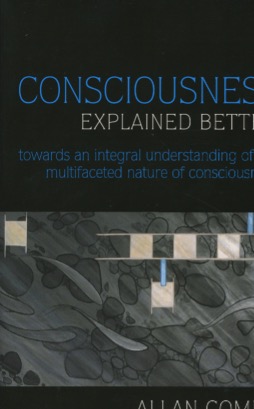
An aside about mentions of Julian Jaynes, whose theory on the right hemisphere was an early inspiration to me: a graduate student at Columbia began his talk citing Jaynes’s book, without verifying or attesting to his theory, and ended his talk referencing Jaynes. Before coming to the conference I had read Allan Combs’s Consciousness Explained Better (a riposte to Daniel Dennett’s early salvo called Consciousness Explained (1992)). Combs opens his own book with Jaynes's initial paragraph, in all its metaphoric musing and alliterative allusions, from The Origin of Consciousness in the Breakdown of the Bicameral Mind. I sought out Combs at the conference to tell him how much I enjoyed his very readable book. He waxed elegiac on Jaynes, not for his theory so much as for the beauty of the writing, considering it the best of its kind in the 20th century.


Final quips and quotes of note: Mental health issues arise from problems in time and space, problems distinguishing self from other. The grandfather of all the senses is the basic tendency to either approach or avoid. Is this good for me or bad for me? Self-preservation asks us to avoid, while self-development suggests we adapt. The Self is both part and whole and when we have no body to maintain we feel bliss (remember that in a Oneness experience we lose our sense of the body’s limits). Our prefrontal lobes are not totally developed until our 20’s and consciousness narrows as a function of age. As we know more, we see less. Rat studies show that the brain is hyperactive in the dying process as it is trying to save the heart in the absence of oxygen. Serotonin surges. These two findings might account for NDEs. Only 5 % of people survive heart attacks and 20 % of them have NDEs. Light is associated with death, mystical experiences and gurus, like Alain Forget, who gives light energy to open the hearts of his students, claiming he is multi-dimensional when he does it. I felt energy pouring out from my heart in my spontaneous San Antonio experience and saw sparks of light spreading out seemingly infinitely beyond me.

It seems I had come to the right place at the right time to get answers to the mysteries of my own heart and mind in a throng of like-minded folks dedicated to understanding consciousness. We are singular and infinite all at once, both awaiting spontaneous gifts of knowledge and struggling hard to make sense of our and others' experiences. I should add that there was a lot of support for belief in reincarnation amongst the presenters.

“In all chaos there is cosmos, in all disorder, a secret order.” C.G. Jung

 “Heaven lies about in our infancy. Shades of the prison house begin to close upon the growing boy.” Wordsworth

“The painter has the Universe in his mind and hands.” Leonardo da Vinci


The Red Book and the Left / Right Emotional Divide

I first bought the large edition of Jung’s long-awaited tome with its magnificent facsimiles of artwork and calligraphy. Both mesmerized and bewildered, I tried to read Sonu Shamdasani's introduction at the back of the book, but it was too large to be functional. Finally, I learned that A Reader's Edition existed. This was manageable and utterly essential to marking passages in the text and taking notes on Shamdasani's invaluable introduction and footnotes. As Shamdasani says, everything Jung ends up saying in future books did indeed come out of this early hallucinatory experience which began during the same time that André Breton and his Surrealist circle were experimenting with their own automatisms and Frederic Myers, Théodore Flournoy and Pierre Janet were studying famous spirit mediums. W.B. Yeats was engaged in séances with his wife, George, as his medium and Jung had a copy of the resulting text: A Vision. The paranormal was in the air and spirit contact was actively pursued.


As I attempted to show in my book, In Their Right Minds: The Lives and Shared Practices of Poetic Geniuses, not everyone has the ability to receive visions, make a planchette move over a Ouija Board, or get answers in a séance. It requires an atypical mind with enhanced right-hemispheric functioning and a partner. Jung fits the mold. First, he had a genetic predisposition to internal division. His mother had two personalities, No. 1 and No. 2; his grandfather, and his cousin, whose séances and splits he studied and encouraged, had the same dissociative tendencies. As a young boy, Jung felt divided between a depressive lonely self and a spirit from an earlier historical period. At the environmental level, Jung suffered from early maternal attachment issues that have been shown to presage a split personality resembling schizophrenia, but more rightly termed dissociation.

On a grander scale, the impending World War threatened his psyche. He had horrific precognitive visions in tandem with his professional break with Freud and an extra-marital relationship with Toni Wolff, who lived in his house as a second wife and shared merged dream states and fantasies with him.* Including his professional interest in troubled minds, we can understand why he felt compelled to write, in painstaking calligraphy, in Latin and German, the words he heard; then illustrated them with brightly colored, tightly controlled, symbolic imagery. As a female voice told him, it was not science, it was art. Further, it was art in service to a suppressed conscious mind.


Jung himself said he felt threatened with madness.** Environmental circumstances reinforced his intention to explore his own psyche through visions and imaginary dialogues. Based on my research into the minds of poetic geniuses, I would say Jung was predisposed to dissociate because of his bilateral brain organization, with neither side dominant, as environmental stressors pushed him over the edge. His use of right-hemispheric poetic writing and highly symbolic, vertically oriented, left-hemispheric painting helped him regain his equilibrium. Both highly verbal and artistic, he retained a helping figure, Philemon, who walked and talked with him, until he was no longer needed. Michael Persinger associates a sense of presence with synchronous activation of both hemispheres.

One of Jung’s early patients provides evidence of a how this type of mind might work. In Memories, Dreams, Reflections, written by Aniela Jaffé using Jung’s notes, much of which ended up on the cutting room floor, we learn of a female patient who heard voices. She described a voice in the middle of the thorax as ‘God’s voice.’ Her other voices were distributed on both sides of her body. The ‘divine’ voice commanded that Bible chapters be assigned before each therapeutic session followed by a test. After six years of therapy, the voices ‘had retired to the left half of her body, while the right half was free of them (127).'" Both sides could speak, with more negativity coming from the right hemisphere; but the left hemisphere, focused on reading and reciting, had healed.


Neuropsychologist D. W. Harrison, writing in 2015, confirms that hallucinations experienced on the left side of the body are negative and coming from the right hemisphere; those experienced on the right are coming from the positive left hemisphere (the proverbial demon on one shoulder, the angel on the other). While writing The Red Book, Jung referred to left- versus right-sided visions. For instance, he describes a vision of a winged being sailing across the sky, coming from the right (= LH provenance), a guru with superior insight, as Shamdasani described him. Jung maintained his therapeutic practice and professional and family activities, retiring to his study in the evenings to engage with his voices and visions.

Even as a child, Jung had been a voracious reader. So, it is not surprising that his readings entered into the dramas he evoked through “active imagination.” Shamdasani traces these influences very well, which included the Bible, Swedenborg, Nietzsche and Dante, in his footnotes to The Red Book. Jung admired art as well. William Blake was an influence, although Jung criticized his predecessor's drawings as artistic rather than an “authentic representation of unconscious processes (Letters 2. Pp. 513-14).” Jung also admired Odilon Redon’s symbolist paintings. The Basilica of Sant'Apollinare in Ravenna, Italy, had a strong impact on Jung (as it had on poet and occultist James Merrill who spent 20 years in Ouija Board sessions with his partner, David Jackson). The frescos and mosaics there translated into Jung’s own “strong colors, mosaic-like forms, and two dimensional figures without the use of perspective (34)."


Parapsychological events occurred in Jung’s house that affected everyone in it. In Shamdasani’s account, Jung’s son raved in his sleep and couldn’t wake up. Asked for paper and colored pencils, he drew “a man angling for fishes with hook and line in the middle of the picture.” Again the left/right emotional divide is evident: on the left was the Devil saying something to the man, but on the right was an angel. Two of Jung’s daughters “thought they had seen spooks in their rooms.” The next day Jung wrote his “Sermons to the Dead,” claiming in Memories, Dreams, Reflections that the haunting stopped as soon as he picked up the pen.

Parapsychological events often occur when a strong emotion trapped inside needs to come out. Poltergeist phenomena in adolescent children have been described this way. Both St. Augustine and French writer George Sand claimed to have heard the words "Tolle, Lege" [Pick up and read] from an external voice, leading to a change in life course. She also had an ambiguously gendered inner figure named Corambé with whom she communicated as a child. This figure disappeared after she wrote her first book in a dissociative state. In times of great stress, inner voices can save a suffering soul. What they and we are all seeking is meaning and a way forward in difficult times.

Were Jung's Sermons “a curiosity from the workshop of the unconscious,” as he would later say, or was there a deeper meaning? What was the strong need to get those words and images on paper? And who was their author? Shamdasani says Jung’s “I" was the author in the "Black Books" section, but it was Philemon in “Scrutinies.” In some sections of Liber Novus it is was the serpent or the bird. The overall theme was “how Jung regains his soul and overcomes the contemporary malaise of spiritual alienation. This is ultimately achieved through enabling the rebirth of a new image of God in his soul and developing a new worldview in the form of a psychological and theological cosmology (Shamdasani 48).” In every poet I have studied who held dissociative discourses with "spirits," the end result included a "new" religion.

In my view, as reason gives way to the irrational, a deeper associative meaning can be uncovered, suggesting, in modern neuroscientific terms, a shutdown of the prefrontal cortex where conscious thought is processed, now expressed through symbols and imagery. The logical left hemisphere is giving way to the mythopoeic right that has similarly informed important religious figures in the past.

Was Jung mad? Richard Hull, Jung’s translator, wrote to William McGuire, who represented Princeton UP papers, saying but for Jung's “hammer[ing] out his experience into a system of therapy that works,” he’d be considered “as mad as a hatter.” Further, “[t]he raw material of his experience is Schreber’s*** world over again; only by his powers of observation and detachment, and his drive to understand, can it be said of him what Coleridge said in his notebooks of a great metaphysician . . . He looked at his own Soul with Telescope / What seemed all irregular, he saw & shewed to be beautiful Constellations & he added to the Consciousness hidden worlds within worlds (March 17, 1961, Bollingen archives, Library of Congress). The citation from Coleridge was indeed used as a motto for Memories, Dreams, Reflections (see fn. 257, p. 94 in The Red Book: A Reader’s Edition).”

By Liber Secundus, Jung seems sure of the Power of the Divine Word that others before him had also received. Writing down the Divine Word protects against “the daimons of the unending, which tear at your soul and want to scatter you to the winds. You are saved if you can say at last: that is that and only that. You speak the magic word, and the limitless is finally banished. Because of that men seek and make words (250).”

From my vantage as a reader of Jung’s text, it often does sound mad, with anomalous sense impressions common to psychotic episodes, including his recognizing highly significant messages that nonetheless cannot be understood because they are seen in unusual scripts such as hieroglyphics. The frightening sound of flapping bird wings as well as seeing “shadow forms” are also common. The accent on negativity that Jung hears in his left ear with the word “Misfortune” also shows right-hemispheric provenance. When the God calls to him, the voice is coming from both sides, which Jung interprets as a middle road; but more likely, it is a synchronization of the hemispheres known to occur in oneness experiences, where a sense of self is lost or the self and the divine are felt as coterminous. The very sense that he is working “against will and intention,” manipulated by an external source, is telling.

Underneath all of the imagery and voices, three things shine through to me: his mother complex, from which he needed to be freed; his conflicted relationship to his pastor father's religion; and the legitimization of his extra-marital relationship with Toni Wolff. When Elijah gives Salome to Jung in The Red Book, he says, “For God’s sake, what should I do with Salome. I am already married and we are not among Turks (435).” Yet a dream will convince him to enter into a sexual relationship with her. The fact that “[a] turbaned Mohammad appears the fourth night after Philemon went away, wearing a long coat and a turban, claiming to bring ‘the bliss of paradise, the healing fire, the love of women (539)” is as telling as Jung’s interpretation of “Philemon’s words that I must remain true to love to cancel out the commingling that arises through unlived love. I understood that the commingling is a bondage that takes the place of voluntary devotion. . . . I had to remain true to love, and, devoted to it voluntarily (540).”

In his epilogue to Liber Novus, Jung wrote that he had worked on the book for 16 years, and then yielded to a study of alchemy, which helped him understand what he had written. He admitted, “To the superficial observer, it will appear like madness. It would also have developed into one, had I not been able to absorb the overpowering force of the original experiences (555).”

A synthesis of supposedly opposing forces occurs in an appendix to Liber Novus: “Logos [male] and Eros [female] are reunited, as if they had overcome the conflict between spirit and flesh. They appear to know the solution. The movement toward the left, which started from Eros at the beginning of the image, now commences from Logos. He starts moving toward the left [the heart side], to complete with seeing eyes what began in blindness (571).”

A final note on the issue of madness: Dirk Corstens, head of the Hearing Voices Network in the Netherlands, does not believe that schizophrenia exists at all; rather, voices are a feature of dissociation, which originates in trauma. The “madness” comes by way of a fearful reaction to the voices. If one engages with the voices, reasons with them, they can be cajoled, tamed, and reduced to harmless or even helping presences. I believe this is what happened in Jung’s case. Through his calligraphy and art, he tamed his mind, bringing about his own healing as well as a system that could and does work for so many others.


*According to Shamdasani's research, while Toni Wolff was in analysis with Jung, she was having incredible fantasies. Jung wrote that "her phantasies entered exactly into my line of thought. Toni Wolff was experiencing a similar stream of images. I had evidently infected her, or was the déclencheur that stirred up her imagination. My phantasies and hers were in a participation mystique. It was like common stream, and a common task [April 1-2, 2011 seminar, Jung Center of Houston]."

**Michael Cornwall believes psychotic episodes should rather be termed spiritual states of emergency better treated with compassionate listening than pharmaceuticals. Paranormal connections such as precognition and voices with important messages are frequently reported in these states.

***Daniel Paul Schreber was a German lawyer and judge who had experienced severe trauma as a child because of his father's onerous child-rearing practices. His brother, under the same regime, committed suicide. Schreber passed through several phases of severe mental illness, hearing voices and developing strange views in a very God-driven narrative, leading to his institutionalization. He was eventually released because of his book, and lived peacefully with his wife for some time. But, when she fell victim to a stroke, he relapsed and spent the rest of his life in the asylum. Freud blamed Schreber's illness on repressed homosexual attraction to his own father. Jung disagreed, ascribing Schreber's case to an identification with female fecundity, as he and his wife had not been able to have children. Childhood trauma and current stressors were certainly behind his relapses. Cruel treatments by the director of the asylum and his wife's lack of visits only contributed to his gender dysphoria and delusions of grandiosity. Apparently, gender identity confusion is fairly common in schizophrenia, bipolar disorder, as well as in dissociative identity disorder. The voices were, in effect, a way to "make sense" of what he was feeling. Similarly to Jung, Schreber described a left ear connection: "inimical souls always aspired towards my head, on which they wanted to inflict some damage, and sat particularly on my left ear in a highly disturbing manner. To his credit, Freud did say that Schreber's delusions were "an attempt at recovery, a process of reconstruction" (see Rosemary Dinnage's introduction to Schreber's book).

Quantum Consciousness Redux

I'm not one to shun anomalous possibilities. If enough strange things happen to you, it's difficult to dismiss the uncanny as all in your head. But, I do tend to think that certain people, owing to genetic predisposition and traumatic experiences, are more open to paranormal experiences. What is the most traumatic experience of all? Dying, of course. 

I've just finished reading Pim van Lommel's book, Consciousness Beyond Life: The Science of the Near-Death Experience. In 2010, I met van Lommel and heard his presentation at the Toward a Science of Consciousness conference in Tucson. He was a serious, intelligent fellow, noticeably Dutch in his yellow pants. Van Lommel is a cardiologist whose job is bringing people back from cardiac arrest. He had heard so many tales of NDEs in his practice that he began to research further. His book is a laudable effort to explain the unexplainable, to grasp the unknowable.


He says that people undergoing NDEs have heightened intuition, clairvoyance, premonitions as well as increased empathy for others, both during and after their experience. It's as though the mind, once opened, remains open, at least for a while. Children are more prone to NDEs, especially through near-drowning. The aftermath can be negative: hypersensitivity to sense impressions, strong emotions; alcohol or drug problems; ADHD, depression or suicidal tendencies. Van Lommel cites Kenneth Ring's connection between out-of-body experiences (OBEs) resulting from childhood trauma and a later propensity to have NDEs. 


Sensing presences, usually departed relatives, and going toward a light in a tunnel are typical of an NDE in all places and at all times. Dutch painter Hieronymus Bosch depicted this in Visions of the Afterlife in the early 16th century. Speech is not necessary in NDEs as verbal communication happens seemingly telepathically. Because of the euphoric sensation, NDErs often do not wish to return to the world of the living until their "spirit" relatives convince them that they must.


Van Lommel spends about half the book describing NDEs, then  explains them scientifically. First he says what they are not (e.g. oxygen deprivation), then what they are: nonlocal, quantum physical events. In an eternal present, past and future are relative and space can be traversed instantaneously. 


I will say that his description of "endless" consciousness as the material world's particle function collapsing into a nonlocal wave function is a useful mental construct that made sense to me. But I'm not sure if I agree that the medium for these messages is in our DNA, as he suggests.

It is well known that environmental effects can either suppress or trigger gene expression. Animals seem to have greater nonlocal connections, witness the tight formations of birds in flight or busy bees following the dictates of their queen at a distance. This is evidence of their genetic unity and of the social composition of their groups. But their brains are much smaller and less complex than ours, making their seemingly robotic adherence to their clustering effects possible. It is also well known that animals can sense dangerous environmental happenings in the near future, like hurricanes, tsunamis, etc. or that their masters are on their way home (Sheldrake). Little gets in the way of their survival instincts.

In human consciousness, in order for the more anomalous features of consciousness to occur, parts of the brain must be offline, shut down or damaged. This is what allows the generally non-verbal visions and knowledge to arise. Dreams, hypnosis, meditation, mental or developmental disorders, epilepsy or altered states brought on with psychotropic drugs are examples. 

A friend of mine is an intuitive healer. In a video interview, she describes how a part of her mind stands aside as she receives inner wisdom that helps her heal herself or others. Van Lommel also cites scientific evidence where fMRIs have registered active changes in the clients of healers who were working at a distance.

Now I'll present my pitch for the right-hemispheric connection in NDEs. First, all of the hypersensitive changes that van Lommel details above, both in the NDE and its aftermath, are aspects of right-hemispheric functioning. It is well known that the left hemisphere processes details, whereas the right's domain is the big picture, broad stroke, associative, emotional and sensorial sphere. Elsewhere, I have written about the right-hemisphere to right-hemisphere connection in telepathy and the mother-infant bond.

Copyright Cartoon A Day / CartoonaDay.com 2009.* 

Doesn't it make sense that the particle function would rely on the logical left, whereas the right would let in the light to both guide and console during our most trying times? Even this beautiful image, frequently seen on the Internet, shows right-brain functioning as "waves." 

Trauma plays a role in opening the mind to the right's associative and/or dissociative wisdom. My friend's experiences with voices began after her mother died and she had started meditating. Both trauma and practice gave her the entry which began, literally, with external fountains of light that she could turn off and on at will. The Sufi poet Rumi once declared: "Don't turn your head. Keep looking / at the bandaged place. That's where / the light enters you."

When I got the startling dream message, "Freud only got it half right. Read the two Hyperion poems," perhaps it was a nonlocal communication from Jung himself. Or perhaps I was dictating to myself through a quantum field what was already known to me in the future. That my dreaming mind could create such wizardry on its own seems unfathomable to me.

In The Secret History of Dreaming, Robert Moss* tells how cigar-smoking Freud, in a dream reported by one of his early patients, got a glimpse of the oral cancer that would cause his death. Unfortunately, Freud failed to recognize what would seem a warning designed just for him. Jung, highly predisposed to voices and visions and practiced in active imagination, had a late-life NDE where he catapulted from his body into outer space during cardiac arrest. The more left-brained father of psychoanalysis sought out the particular sexual underpinnings in the mental illnesses of his clients. The right-brained Jung saw the archetypal dimension that we all share. His notion of the collective unconscious could be explained using the nonlocal paradigm. But maybe the right hemisphere deserves some credit for allowing the magic to happen.

*Moss's bio says he survived three NDEs in his own childhood.


*Content originally appeared on CartoonADay.com (http://www.CartoonADay.com), and is made available through a Creative Commons Attribution Noncommercial license (http://creativecommons.org/licenses/by-nc/2.5/). 


Hughes, Plath and Shakespeare: A Twinned Tale of the Mythic Feminine


In the photo on the left, we can see that Ted Hughes was a right-handed poet; yet, in the second photo, his arms are folded across his chest with the left hand up. Possible mixed dominance, along with early trauma, may explain his penchant for poetry and the paranormal. Looking at his childhood, we find a distant mother; a silent father, traumatized by his experiences in war; a favored older brother, Gerald. A fear of female engulfment with a need for ever-renewed female collaboration mark Hughes's entire creative life. This conflict could be traced back to attachment issues.
   
Furthermore, Hughes’s mother was considered a psychic and he believed that he had inherited her abilities. Whereas she had premonitory visions and angelic visitations, he had what he deemed prophetic dreams. Early on, Ted claimed the image of the bloody hand of a fox on a paper he was writing at Cambridge convinced him to read archeology and anthropology, rather than English literature. In another dream, an angel had shown him a small square of satin, which he later came to believe was the same material that lay under his dead wife’s head in her casket. [I have no aversion to the notion of answers and warnings in dreams, as I have received them myself (cf. Hearing the Voice Getting it Right)
   
Hughes also cultivated the paranormal through hypnosis, trance, and meditative exercises. He fancied himself a shaman and believed a poet’s future self could dictate to him in the present. [If we accept the latter, a notion that I find very appealing, even if not scientifically provable,* it could be one way of explaining a dissociative sense of dictation.]

As a young man, Hughes was in thrall to poet and classicist Robert Graves’s notion of the White Goddess, the mythic female who inspires poets, yet demands their sacrifice in return for immortality. He was taken in enough to write an entire book called Shakespeare and The Goddess of Complete Being, a long, complex attempt to order the bard's entire opus based on how the mythic feminine is portrayed in his plays
   
The wild boar goring Adonis on the cover represents the mortal wound inflicted on the Hero. Hughes believed, in line with this mythic scenario, that a major trauma was needed to confer special knowledge on the poet. According to Hughes, Shakespeare's personal trauma was the “tragic error” of abandoning his wife in Stratford while he went off to London, compounded at the societal level by the suppression of the Catholic tradition in England. Both devalued the Feminine. Shakespeare’s visionary poetry, then, erupted at the confluence of these major crises and was aided by his adherence to a mystical school of thought (Hermetic Occult Neoplatonism) that used ritual magic to glean wisdom and clairvoyance from hallucinatory figures. [Think Jung.]

Hughes uses a hemispheric model to explain the mythic paradigm in Shakespeare’s entire corpus. The old Goddess myth stands on the right—archaic, matriarchal, emotional, and body-based—while the Goddess-destroying myth leans left—new, patriarchal, rational, and idealized. The Female of the right is “inseparable from the womb memory, infant memory, nervous system and the chemistry of the physical body, possessed by all the senses and limitless”; the Female of the left is “Puritan . . . idealized, moralized and chaste.” 

What happens next is madness: the Hero murders his own beloved, supplanting the old “King must die” mentality of ancient Goddess religion with “the beloved Female must die” instead. The Hero splits the Female into two diametrically opposed aspects: Sacred Bride/Divine Mother versus Queen of Hell.

Hughes asserts that there is a basic biological truth underlying the new patriarchal formula. First, the Hero is driven mad by the terrifying fact that all of life is doomed. Second, the growing boy needs to overthrow the “possessive control of the Female,” that is, his mother, in order to become a man. Likewise, the mythic hero must overthrow the Mother Goddess because of her “magical, terrifying, reproductive powers”; “the occult power of her paralysing love”; and unleash the “uncontrollable new sexual energy which is searching for union with the unknown Female.” In other words, the conquering god appropriates the Mother Goddess’s power while assuring female subservience and his own sexual liberty. This phase was not to last. Hughes sees a great shift in Shakespeare’s plays coinciding with his mother's death in 1608: from this point onwards, saving, rather than killing off, the Female becomes his credo. Restoration of the Divine Female heals the crime against her, so that it cannot occur again.

In fixating on Shakespeare’s oeuvre, ferreting out the underlying myths that spelled out his doom and resuscitation, Hughes had found a twinning of his own sad tale. Shakespeare’s “flight from his wife, and his prolonged separation from her, is one of the dominant unsettled questions of his solitary existence,” Hughes proclaimed. Likewise, his flight from Sylvia Plath and her subsequent suicide, was only the first in a series of deaths that would encompass a man’s most intimate female relations: a wife; a lover, Assia Wevill; their daughter, Shura; and his own mother. Female corpses of Shakespearean proportion piled up at the feet of a broken, depressed poet. 

Hughes says that Shakespeare “examines” and “corrects” his life by resuscitating the fallen female with “atonement, redemption and reconsecration in a sacred marriage of  ‘new-born’ souls.”  Likewise, Hughes will attain the status of one of the great poets of the twentieth century and Poet Laureate of England. The Female-affirming final sequence of Shakespeare’s oeuvre represents for Hughes a “crowning illumination” because it attempts to cure the bard’s personal wound as well as the religious rift in his society. Perhaps Hughes's Remains of Elmet and Birthday Letters had a similar effect on him, restoring the beloved mother and wife to him, without the curse of Medusa’s snare. Mother and wife take on their separate posthumous lives, extolled and molded by the poet’s imagination, freeing him, at last, from their mythic hold on him. 


Plath says, “God is speaking through me” in Hughes’s poem “The God.” The Divine "Other" filled the vacuum left by her husband,  who had replaced her father. In his Birthday Letters, Hughes neatly lays his wife’s soul to rest, on that little square of dream satin, producing some of his finest poetry along with the myth of his own innocence.


*See http://dbem.ws/FeelingFuture.pdf, in which Daryl J. Bem presents new scientific evidence on precognition and premonition. Next week, I will be attending the 2012 Toward a Science of Consciousness Conference in Tucson, Arizona, where this Cornell University professor will be speaking, along with Deepak Chopra and many others researchers and practitioners, at the interface of science and spirituality.