Carole Brooks Platt, Ph.D.


Carole regularly attends the Science of Consciousness Conference in Tucson, AZ, except 2020, the year of the coronavirus. She has presented her research there, as well as at poetry events and other academic settings.


Her work was originally informed by Julian Jaynes's theory on the hallucinatory origins of poetry and prophecy in the right hemisphere of the brain.


She was an invited speaker at the Julian Jaynes Conference in Charleston, WV, in 2013, and, more recently, at a symposium on "Further Reaches of the Imagination II" at the Esalen Center for Research and Theory in Big Sur, CA, Nov 1-6, 2015. She was also invited to speak at the Poetry by the Sea global conference in Madison, CT, May 2016, but, unfortunately, was unable to attend.

On February 23, 2017, she presented her research at the Jung Center of Houston.


Her book, In Their Right Minds: The Lives and Shared Practices of Poetic Geniuses, brings together all of her literary and neuroscientific research and was an Amazon Hot New Release in Neuropsychology and Poetry / Literary Criticism.


Carole also provides research on hemispheric differences, atypical lateralization, and handedness at:

https://www.facebook.com/RightMindMatters/.


Carole is currently working on a book on female mystics and mediums, beginning with Joan of Arc, and female poets who felt aligned with Joan. Carole's popular stand alone article on Joan of Arc is available for purchase from her publisher:


https://www.ingentaconnect.com/content/imp/jcs/2019/00000026/f0020011/art00008

Leonardo's Brain and Leonard Shlain

Like most people writing about the brain, Shlain (2014) focused first on a “universal model” which recognizes the primacy of the left hemisphere for language, linearity and logic while the right indulges in emotionality, poetry, creative artistry and humor. With his dual scientific and artistic genius, Leonardo did not fit the “typical” dominance mold. Shlain proposed that Leonardo’s brain was bilaterally organized, with neither side favored over the other. With this cerebral balance, Leonardo could be both an “extraordinary left-brained academician obsessed with portraying perspective correctly and an impish right-brained trickster who takes delight in fooling the viewer with perspectivist sleights of hand (7).” Leonardo, per Shlain, excelled in both science and art thanks to a large corpus callossum with more than typical neurons connecting the left and right hemispheres.      
      I was initially pleased that Shlain wrote about Leonardo’s childhood traumas because it fit my own paradigm of the creative poetic mind. Leonardo was the illegitimate child of a peasant girl and a rich city boy. His mother, whose marriage to another man had been arranged by Leonardo’s father’s family, raised him in the countryside. But, when Leonardo’s biological father married a 16-year-old girl, he moved his now 5-year-old son back into his own household, separating him from his biological mother. The new stepmother died in childbirth. Leonardo’s father married three more times, producing ten more children. This all sounds highly traumatic, but Leonardo would be well raised by his grandparents and his uncle Francesco (Capra: 66).

       When Leonardo’s grandfather died and Francesco married, even these losses led to a significant gain for the now 12 year old. Leonardo left the farm for the beautiful, artistic city of Florence with his father. He began an apprenticeship with an important artist and craftsman, a friend of his father’s, several years later. According to Fritjof Capra (2007), this intellectual and creative environment “shaped” Leonardo’s “entire approach to art and science (73).” He had at his disposal all the equipment and materials he needed for his many inventions in this workshop. In a later move to Milan, he was given a large workspace to fulfill his artistic duties to the court and do research on his burgeoning scientific and mathematical interests, especially geometry, along with access to the large and important library at the University of Pavia.
      Leonardo led a seemingly charmed life. He was considered by one and all to be physically beautiful; a flamboyant dresser; loving, eloquent and charming; an athlete; an excellent horseman; a musician, and serenely self-confident (Capra: 18-21). Nonetheless, at the societal level, his illegitimacy barred him from attending university; he did not begin learning Latin, necessary for reading most scholarly works, until he was 40 years old. This very constraint may have impelled his insatiable scientific inquiries through direct observation and his need for perfection in his art. We should also recall that he was a product of his times. Being a “Renaissance” man required knowing everything then, as it does now.
      Yet, an underlying difference in Leonardo’s brain lateralization cannot be denied. Shlain (2014) quotes Leonardo’s Treatise on Painting (1651), which advised artists how to “quicken the spirit of invention”:

  • You should look at certain walls strained with damp, or at stones of uneven colour. If you have to invent some backgrounds you will be able to see in these the likeness of divine landscapes, adorned with mountains, ruins, rocks, woods, great plains, hills and valleys in great variety; and expressions of faces and clothes and an infinity of things which you will be able to reduce to their complete and proper forms. In such walls the same thing happens as in the sound of bells, in whose stroke you may find every named word which you can imagine (61).

While possibly good advice, it tells us more about the extent of Leonardo’s own active imagination and his ability to convert environmental sights and sounds into a new vision or voice, transformed from a stain on a wall or heard in clanging bells. Leonardo’s advice notwithstanding, this is not a universal skill. Rather, it is more likely encountered in altered states of consciousness, from whatever the source—sleep deprivation, isolation, drug usage, or organic injury to the brain, such as epilepsy or head trauma. A left-hander’s bilaterally organized brain, with an enhanced right hemisphere, could make associative visual or auditory connections that typical minds could not.[1]
      Shlain was one of the first writers to accent the left versus right hemispheric differences in creativity, based on important theorists of the 1980’s. I agree with him that myths derive from left-hemispheric confabulated stories trying to make sense of anomalous right-hemispheric voices and visions. Shlain says,

  • Although each hemisphere has its own preferences and approaches, each contributes to make a whole person only when the corpus callosum integrates the two. But in the process of generating a major creative insight, a disconnect must occur between the two halves. Arthur Koestler called this the ‘hemispheric bisociation’ (91-92) . . . [Koestler also described the act of creation as “thinking aside” and it was clear to him that there could be no truth without beauty, whether artistic, mathematical, or scientific. If you look closely at the tattered cover of my 1989 edition of Koestler's classic, you'll see that the figure is tossing about pages of Leonardo's drawings, a poem, and musical notes. [These were the days when cover art was beautifully enigmatic, not diagrammatic or technological.]

Still describing the typical mind, Shlain says the “the right brain is essentially bereft of language, the description in words of how the creative process proceeds is practically impossible. Ask artists or scientists how they arrived at their most novel and creative work, and you will no doubt receive either an inarticulate answer or the left brain’s confabulation (98-9).” He does not postulate that language can be dominant on the right or spread out in both hemispheres.
      Beyond his reliance on science mostly from the 1980’s, Shlain comes to this odd conclusion about creativity:

  • Creativity is at its base a combination of fear and lust. Danger and sex are the fundamental processes that artists traditionally call upon to create a work of art. Of course, he or she is not aware that these are the root causes. Creativity begins with perceiving a pattern, a feature, or an alternative use for a common object.[2] After recognizing something novel, the artist breaks down the observation into its component parts. This is primarily a left-brained function, reductionist and analytic. An artist will reassemble the pieces into a new and compelling manner that others will recognize as art. But the work of art must contain ‘passion.’ It must be a work of ‘love.’ He or she must be in a nearly ‘orgasmic’ state to produce it. Our word enthusiasm comes form Dionysian enthousiasmos, a wild state of holy inspiration. Orgasm is a right-hemispheric function. Love is rooted in the right brain. Ecstasy is an emotion experienced at the right of the corpus callosum (100-101).”
     Pursuing Leonardo’s cerebral differences, Shlain explains that the anterior commissure, which connects the temporal lobes, can be as much as 30 percent larger in women than men, 15% larger in gay men than straight men and larger still in both left-handed men and women. Most authors agree that Leonardo was left-handed and possibly gay, so he would indeed have had a more bilateral brain. Fritjof Capra (2007) says the artist was ambidextrous, able to write equally well with both hands.
      What about the mirror handwriting? Some authors agree that Leonardo wrote backwards so as not to smear the ink (Shlain; Nathan and Zöllner). Shlain adds that “[l]eft-handers must employ hook handwriting to avoid this distressing trait when they write from left to right (173).” Again, as a left-hander, and with confirmation from others on my blog post “The Eye of the Beholder,” I know that all left-handers do not hook their hand when writing. It depends on whether they are left or right dominant for language (President Clinton does not hook his hand. President Obama does). If indeed Leonardo’s mirror writing was designed to avoid smearing the ink, it would put his language function more squarely in the left hemisphere, reserving the right for visuo-spatial processing. The fact that he drew facial profiles to the right and his background hatching ran top left to bottom right shows a left-hander at work (Nathan and Zöllner: 137, 196). 


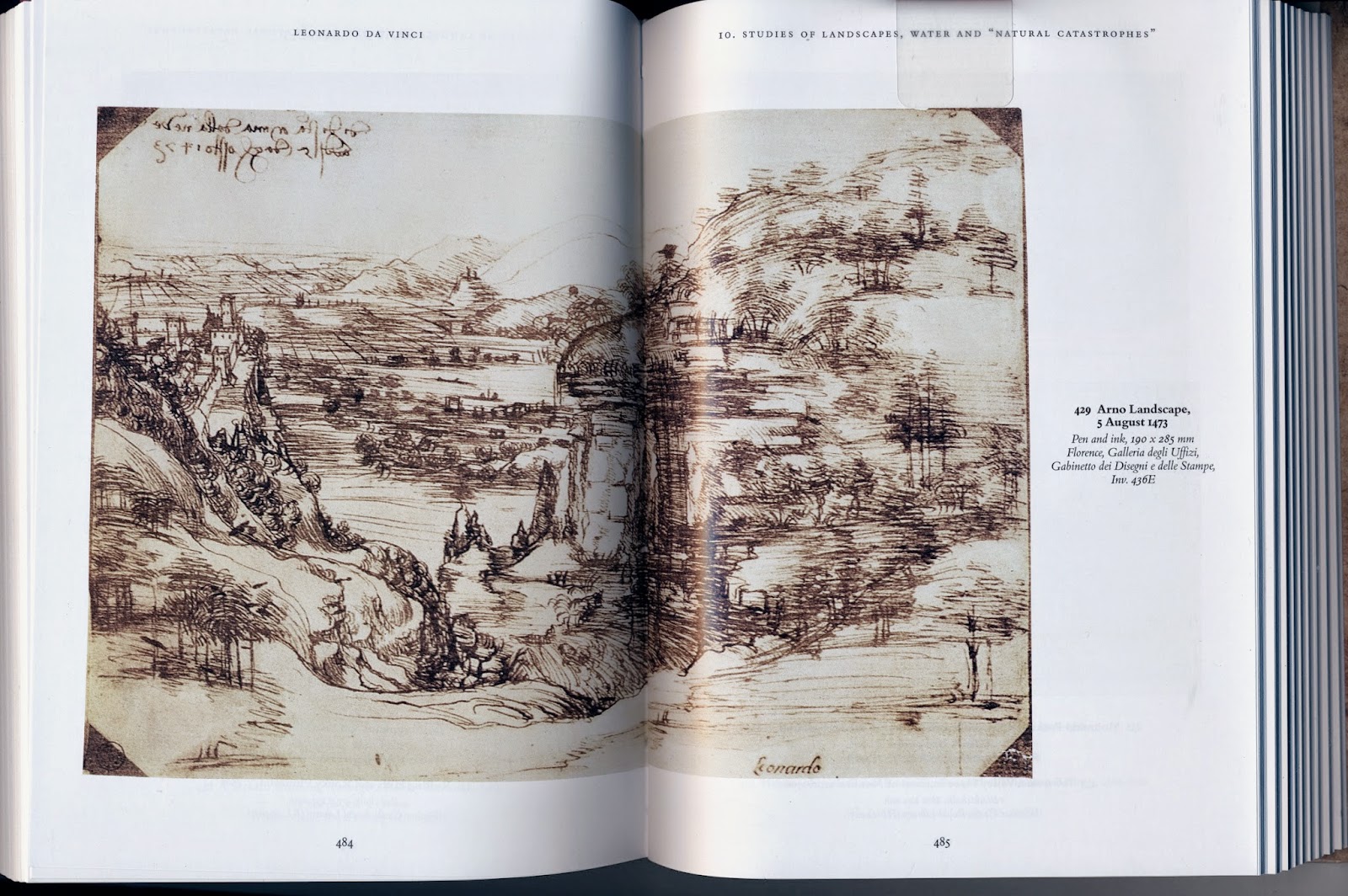
His impressive maps were in part drawn on Ptolemy’s Geographia, but he was also a mountaineer. His aerial views may well have been part visionary, part actual, part imaginary, like so much of his work (image below in Nathan and Zöllner: 484-5). Shlain suggests that Leonardo practiced remote viewing to get these views on paper. I will not discount the possibility of non-local perception, given the extent of Leonardo’s bilateral dominance, with enhanced right-hemispheric functioning.


   Shlain recognized that Leonardo’s language was highly metaphorical and that poetry is right-hemispheric language, as professor and poet Julie Kane has explained. Shlain’s conclusion, specifically with regard to the Renaissance artist, is well put, but requires refinement: “Leonardo had all the characteristics of the brain that would allow for an increased sensibility to aesthetics, harmony, and creativity. They were present as the result of differences in the organization of the possibly gay, left-hander’s, musical, backward-writing, ambidextrous brain (175).”
      While I am indebted to Shlain for the biographical details on Leonardo da Vinci’s early life, and agree in principle with the bilateral thesis, we need a fuller picture to understand the artist’s mind and practices. Capra, for instance, says Leonardo’s notes for his drawings were not only written backwards, they were “disjointed,” using “highly idiosyncratic” spelling and syntax, no spaces between words, and virtually no punctuation other than periods. It is quite possible that he was dyslexic, with compensatory visual prowess, or, possibly, that he was merely in a rush to get the words down, while perfecting his images, over and over again. Leonardo himself asserted that drawings were much important than words and painting more important than poetry (Capra: 39, 143).      
     Leonardo also did more drawings than paintings when usually the reverse is true for artists (Nathan and Zöllner: 12). An enormous percentage of his works has been lost and no studies remain for the Mona Lisa (Nathan and Zöllner: 16). What is especially interesting to me is his visuo-spatial capacity. Rather than drawing from a model, he was often drawing on memory alone and actually sought out certain faces on the street to be captured on paper only after returning to his study.  
     The fact that Leonardo never systematized his scientific work, according to Capra, shows him to be deliberately secretive, making it more difficult for others to steal his ideas. He even "designed his study so that the platform holding his work could be lowered through the floor to the story below . . . to hide it from inquisitive eyes whenever he was not working (Capra: 27)." Critical transcriptions that do exist to decipher Leonardo’s mirror writing, which has proven to be "highly eloquent, often witty, and at times movingly beautiful and poetic (Capra: 166-8)," suggest a right-hemispheric provenance for language.
      Even Leonardo’s study of science sounds right hemispheric, because his focus was on patterns, not logical sequences. The Dyslexic Society claims many artists and inventors among their ranks, including Leonardo. Capra (2007) realized that:
  • Leonardo’s systematic studies of living and nonliving forms amounted to a science of quality and wholeness that was fundamentally different from the mechanistic science of Galileo and Newton. At the core of his investigations, it seemed to me, was a persistent exploration of patterns, interconnecting phenomena from a vast range of fields (Capra: xviii).
     Capra cited an exhibit of Leonardo’s drawings at the Hayward Gallery in London, which summarized the master’s art as "part of a vision embracing a profound sense of the interrelatedness of things (Capra: xix)." I see it as analogical thinking (right-oriented) at its height, combined with an unprecedented attention to detail and an obsessive need to depict the real, as it actually is (left-oriented), as well as moving through time and space (non-local). Science and art were synthesized, even synchronized, showing whole brain simultaneous processing. Leonardo also had a prodigious memory, capable of holding enormous amounts of visual information in mind before committing it to paper or canvas, which, complementing his insatiable, intellectual curiosity, provided the intuitive means and the practical skill to get whatever he saw right, with a minimal use of words.
      Leonardo never accepted blindly the words in classical texts; rather, he did his own experiments and directly observed nature to decide for himself (Capra: 156). As to art, he could do both linear perspective drawings with mathematical precision and hyperrealistic human and animal drawings, the former left hemispheric and the latter, right hemispheric, in my opinion. His art was scientific and his science artistic, accenting one side or the other at will, depending on the eyes’ focus and the mind’s intent. Leonardo’s vision, thought processes and memory were so keen that intuition, a form of cognition for him, permitted him to make inventive leaps centuries ahead of his time.
      Mind must have a body and a brain, so Leonardo did not believe in disembodied spirits or an afterlife. But he did believe in the importance of the mother, beautifully expressed in this passage from his notebook that accompanied his splendid drawing of the fetus in the womb:
  • One and the same soul governs these two bodies; and the desires, fears, and pains are common to this creature as to all other animated parts. . . . The soul of the mother . . . in due time awakens the soul which is to be its inhabitant. This at first remains asleep under the guardianship of the soul of the mother who nourishes and vivifies it through the umbilical vein (in Capra: 254). 
      
Capra says succinctly: "Never again . . . was so much intellectual and artistic genius embodied in a single human being (259)." Leonardo apparently agreed, acknowledging about himself:

 Read me, O reader; if in my words you find delight,
 For rarely in the world will one such as I be born again.

Capra, Fritjof. 2007. The Science of Leonardo: Inside the Mind of  
    the Great Genius of the Renaissance. New York: Doubleday.
Kane, Julie. 2004. "Poetry As Right-Hemispheric 
     Language."Journal of Consciousness Studies, 11 (5-6): 21-59.
Koestler, Arthur. 1964/1989. The Act of Creation. London and New      York: Arkana.
Nathan, Johannes and Zöllner, Frank. 2014. Leonardo da Vinci 
      1452-1519: The Graphic Work. Cologne: Taschen.
Shlain, Leonard. 2014. Leonardo's Brain: Understanding Da 
      Vinci's Creative Genius. Guilford, CT and Helena, MT: Lyons
      Press.


[1] As a left-handed, right-dominant person myself, I can provide a telling example. I once made a journey from the US to France with a long layover in London. Not having slept the entire night in Heathrow Airport, I boarded a small plane bound for Toulouse and immediately fell asleep. In that moment, I saw a static hypnagogic image of a ship crossing the English Channel with a crusader standing at the helm, white tunic and bright red cross gleaming. After arriving in Toulouse, and driving with my son to my destination on unfamiliar roads, I fell again into a fitful sleep. In the morning, I awoke to frightening images of “monkey men” projected onto the rough-hewn walls of the medieval stone house where I was staying.
[2] This is a common scientific study method, which, I consider unsuitable for judging artistic creativity.

Quantum Consciousness Redux

I'm not one to shun anomalous possibilities. If enough strange things happen to you, it's difficult to dismiss the uncanny as all in your head. But, I do tend to think that certain people, owing to genetic predisposition and traumatic experiences, are more open to paranormal experiences. What is the most traumatic experience of all? Dying, of course. 

I've just finished reading Pim van Lommel's book, Consciousness Beyond Life: The Science of the Near-Death Experience. In 2010, I met van Lommel and heard his presentation at the Toward a Science of Consciousness conference in Tucson. He was a serious, intelligent fellow, noticeably Dutch in his yellow pants. Van Lommel is a cardiologist whose job is bringing people back from cardiac arrest. He had heard so many tales of NDEs in his practice that he began to research further. His book is a laudable effort to explain the unexplainable, to grasp the unknowable.


He says that people undergoing NDEs have heightened intuition, clairvoyance, premonitions as well as increased empathy for others, both during and after their experience. It's as though the mind, once opened, remains open, at least for a while. Children are more prone to NDEs, especially through near-drowning. The aftermath can be negative: hypersensitivity to sense impressions, strong emotions; alcohol or drug problems; ADHD, depression or suicidal tendencies. Van Lommel cites Kenneth Ring's connection between out-of-body experiences (OBEs) resulting from childhood trauma and a later propensity to have NDEs. 


Sensing presences, usually departed relatives, and going toward a light in a tunnel are typical of an NDE in all places and at all times. Dutch painter Hieronymus Bosch depicted this in Visions of the Afterlife in the early 16th century. Speech is not necessary in NDEs as verbal communication happens seemingly telepathically. Because of the euphoric sensation, NDErs often do not wish to return to the world of the living until their "spirit" relatives convince them that they must.


Van Lommel spends about half the book describing NDEs, then  explains them scientifically. First he says what they are not (e.g. oxygen deprivation), then what they are: nonlocal, quantum physical events. In an eternal present, past and future are relative and space can be traversed instantaneously. 


I will say that his description of "endless" consciousness as the material world's particle function collapsing into a nonlocal wave function is a useful mental construct that made sense to me. But I'm not sure if I agree that the medium for these messages is in our DNA, as he suggests.

It is well known that environmental effects can either suppress or trigger gene expression. Animals seem to have greater nonlocal connections, witness the tight formations of birds in flight or busy bees following the dictates of their queen at a distance. This is evidence of their genetic unity and of the social composition of their groups. But their brains are much smaller and less complex than ours, making their seemingly robotic adherence to their clustering effects possible. It is also well known that animals can sense dangerous environmental happenings in the near future, like hurricanes, tsunamis, etc. or that their masters are on their way home (Sheldrake). Little gets in the way of their survival instincts.

In human consciousness, in order for the more anomalous features of consciousness to occur, parts of the brain must be offline, shut down or damaged. This is what allows the generally non-verbal visions and knowledge to arise. Dreams, hypnosis, meditation, mental or developmental disorders, epilepsy or altered states brought on with psychotropic drugs are examples. 

A friend of mine is an intuitive healer. In a video interview, she describes how a part of her mind stands aside as she receives inner wisdom that helps her heal herself or others. Van Lommel also cites scientific evidence where fMRIs have registered active changes in the clients of healers who were working at a distance.

Now I'll present my pitch for the right-hemispheric connection in NDEs. First, all of the hypersensitive changes that van Lommel details above, both in the NDE and its aftermath, are aspects of right-hemispheric functioning. It is well known that the left hemisphere processes details, whereas the right's domain is the big picture, broad stroke, associative, emotional and sensorial sphere. Elsewhere, I have written about the right-hemisphere to right-hemisphere connection in telepathy and the mother-infant bond.

Copyright Cartoon A Day / CartoonaDay.com 2009.* 

Doesn't it make sense that the particle function would rely on the logical left, whereas the right would let in the light to both guide and console during our most trying times? Even this beautiful image, frequently seen on the Internet, shows right-brain functioning as "waves." 

Trauma plays a role in opening the mind to the right's associative and/or dissociative wisdom. My friend's experiences with voices began after her mother died and she had started meditating. Both trauma and practice gave her the entry which began, literally, with external fountains of light that she could turn off and on at will. The Sufi poet Rumi once declared: "Don't turn your head. Keep looking / at the bandaged place. That's where / the light enters you."

When I got the startling dream message, "Freud only got it half right. Read the two Hyperion poems," perhaps it was a nonlocal communication from Jung himself. Or perhaps I was dictating to myself through a quantum field what was already known to me in the future. That my dreaming mind could create such wizardry on its own seems unfathomable to me.

In The Secret History of Dreaming, Robert Moss* tells how cigar-smoking Freud, in a dream reported by one of his early patients, got a glimpse of the oral cancer that would cause his death. Unfortunately, Freud failed to recognize what would seem a warning designed just for him. Jung, highly predisposed to voices and visions and practiced in active imagination, had a late-life NDE where he catapulted from his body into outer space during cardiac arrest. The more left-brained father of psychoanalysis sought out the particular sexual underpinnings in the mental illnesses of his clients. The right-brained Jung saw the archetypal dimension that we all share. His notion of the collective unconscious could be explained using the nonlocal paradigm. But maybe the right hemisphere deserves some credit for allowing the magic to happen.

*Moss's bio says he survived three NDEs in his own childhood.


*Content originally appeared on CartoonADay.com (http://www.CartoonADay.com), and is made available through a Creative Commons Attribution Noncommercial license (http://creativecommons.org/licenses/by-nc/2.5/). 


The Minds of the Poets: Sylvia Plath and Ted Hughes


A different entrée into the minds of Sylvia Plath and Ted Hughes comes via Previc’s (2009)[i] theory of the dominant neurotransmitters in men and women. In his view, the male mind tends towards left dominance with its abundant dopaminergic connections and a “detached,” “exploitative,” “linear” orientation towards future time and distant space; while the female mind is more right-hemispheric and serotonergic, interested in maintaining a close circle with communal, empathetic ties. In a nutshell, one could evoke the Paleolithic hunter versus the nurturing mother model. Previc’s theory is in many ways convincing; but, as with McGilchrist’s The Master and the Emissary, it does not take into account atypical right-hemispheric dominance, with switched hemispheric functions, or temporary reversals of normal linguistic dominance during manic states, or brain volume changes due to head injury or early trauma on the left that can release the right from the left’s inhibitory signals or vice versa.


Nonetheless, Ted Hughes possessed many traits of Previc’s highly dopaminergic male. Hughes was a hunter, with disheveled, unwashed ways. He was both highly intelligent and hypersexual, more interested in sexual conquest than in maintaining close bonds. He was thrilled at the birth of his daughter, Frieda, but less enthralled when his son, Nicholas, arrived. His lover, Assia Wevill, had a child, Shura, whom he never recognized as his daughter. He would abandon Assia, as he did Sylvia Plath. He will maintain a relationship with Brenda Hedden, marry Carol Orchard, then spend their honeymoon period with Hedden, dangling her along until she breaks it off.[ii] Brenda’s remarks exemplify the highly dopaminergic male’s need for conquest, not domesticity, which would also explain Hughes’s intense identification with Robert Graves’s theory of the White Goddess who abhors domesticity:
           
"He was a real hunter. The moment I drew away from him and became independent, I was more attractive in his eyes, and he chased me and pleaded that I would come back. It was the same with Assia: when she tried to break away and was out of his reach, he became motivated. But, when they were together, he did terrible things. I feared I would end up like her, and resisted his temptations. Her terrible suicide saved my life."[iii]


   Plath was highly intelligent, ambitious and sexually motivated as well, the dopaminergic side of her. But, living in a time when women were considered “sluts” if they acquiesced to male sexual overtures, she was very conflicted. She labeled her first experience a rape and had to go to the hospital for hemorrhaging, yet still went out with the man again. There were more men, sometimes involving violent sex, to whom she consented, whether as punishment or titillation.[iv] After marriage, she often commented on her “good” love-making sessions with her husband, considered crucial to their marriage, even though there was often violence involved there too.[v]

   Plath’s positive serotonergic side came out in maintaining a tidy home, cooking delicious meals and nurturing her children, while remaining deeply bound to her husband. She was initially attracted to Hughes because of his brute strength as well as his poetry, having long acknowledged her need to be dominated by a strong male who would not be jealous of her own ambitions. Only he seemed large enough, both physically and mentally, to fit her fantasy. In fact, during her marriage, as her serotonergic self waxed, her dopaminergic creativity waned. The final abandonment will spawn her best poetry with fierce words and bold imagery, suggesting a dopamine-mediated manic shift. Never particularly religious, she will now claim that God is speaking through her, another sign of mania, according to Previc.

  In addition to the abandonment, other physical and psychological factors must be implicated in her final tragedy: genetic predisposition to a mood disorder; the loss of her father at age 8, which will be felt and filtered again and again with each rejection, failed relationship and abandonment; badly administered ECT treatment; therapy which overplayed maternal hatred and underplayed the father’s role; a miscarriage; an appendectomy; post-partum depression; an upper-respiratory illness; some negative  reviews of The Bell Jar; long bouts of waiting by her window for Hughes to reappear; and, possibly, side effects from a new antidepressant. Her British doctor, John Horder, called her "pathologically depressed" and abnormally sensitive (Alexander, p. 325).

  In the end, Plath was coping with the coldest winter in London since the early 19th century, with intermittent loss of light, heat and no telephone, plus an altercation with and loss of her au pair. Despite the urgency and publishing potential of the fiery new Ariel poems, an upcoming assignment for the BBC and a slated meeting with her British editor that day, she commits suicide. One would be tempted to say that her depressive side got the upper hand, but her odd behavior on the night of the suicide, as recounted by her downstairs neighbor, Trevor Thomas, suggests, rather, a manic shift. Wanting to pay for stamps he had given her that night,  she tells him "Oh! but I must I must pay you or I won't be right with my conscience before God, will I?" Ten minutes later, when Thomas finds her still in the hallway, he says he'll call their mutual Dr. Horder. Plath replies, "Oh, no please, don't do that. I'm just having a marvelous dream, a most wonderful vision." Perhaps it was in some kind of waking dream state that she made her preparations to die. Yet, true to her serotonergic self, she also prepared a small meal of milk and buttered bread for her children who slept safely behind a door sealed off from the deadly gas fumes that would engulf her alone (quotes from Alexander, p. 329). 

  Plath's mother wrote these poignant words at the end of her Letters Home

“Her physical energies had been depleted by illness, anxiety and overwork, and although she had for so long managed to be gallant and equal to the life-experience, some darker day than usual had temporarily made it seem impossible to pursue.” 


  Hughes will come to blame a triple threat: Plath’s mother, her therapist, and an unnamed friend for poisoning his wife’s mind against him. In a late poem, he questions his wife: “What was poured in your ears / While you argued with death? / Your mother wrote: ‘Hit him in the purse.’ / . . . And from your analyst: / ‘Keep him out of your bed’ / . . . / What did they plug into your ears / That had killed you by daylight on Monday?” (Howls & Whispers). But a final blow to her was the inscription she found in a new copy of a red Oxford Shakespeare during their last meeting in his flat. Assia had replaced what Sylvia had furiously rent when she first discovered their adultery. This lover would be remorseless when learning of the wife's demise. 

  Hughes himself claimed the relationship with his wife had been "almost completely repaired" before the fatal day (in Koren and Negev). One will never know what occurred between Sylvia and Ted during their last brief encounter on the evening of February 8 at her own flat in Yeats's old house; but, on returning to her friend Jillian Becker's, who was watching the children, she appeared distinctly different from her formerly sobbing self, now "direct" and "purposeful" (in Alexander, p. 328).

  Whatever the constellation of events, one can only wish that Plath had waited, had not succumbed to that darker day, or brighter, if the manic hypothesis prevails. Acknowledged and consoled by the recognition that would follow, she might well have flourished. In 1982, she received the Pulitzer Prize for her Collected Poems along with the enduring adoration of so many, many others.


[i] See Previc (2009), The Dopaminergic Mind in Human Evolution and History (UK: Cambridge UP).
[ii] See Koren and Negev (2006), Lover of Unreason: Assia Wevill, Sylvia Plath’s Rival and Ted Hughes’ Doomed Love (UK: De Capo Press) for evidence of Hughes’s callous ways with women. In a letter to his brother, Gerald, Hughes “confessed that he had finally found it impossible to stay married to Sylvia, especially because of her ‘particular death-ray quality,’ and that he was pleased to have left her (ibid., p. 110)."
[iii] Ibid., p. 221.
[iv] Think Sabina Speilrein and Jung.
[v] Alexander (1991), Rough Magic: A Biography of Sylvia Plath (New York: Viking) provides many examples of the “rough magic” in her sex life.

Consciousness of the Future at the TSC


The Toward a Science of Consciousness (TSC) Conference has been going strong since 1994. Faithful followers and newcomers are equally aware that consciousness studies are still evolving, moving closer, albeit elusively, toward an understanding of what consciousness is and how it arises. No one claims it’s some sort of brain substance: it's a process, not a thing and it definitely arises through interaction with others and the environment. What’s nice about this conference is how it explores both the hard scientific and philosophical matters—How does consciousness arise? Do we have free will?—and the other phenomena, harder to prove —Does consciousness survive death? Can we foresee the future (precognition)? Can acts in the future affect the past (retrocausation)? 

The large gathering includes neuroscientists, philosophers, psychologists, neuropsychologists, anesthesiologists, spiritual types, survival of death advocates and literary people (like me, although a minority). I heard a talk on consciousness in Virginia Woolf this year and had a pleasant interchange with the speaker, a philosopher, afterwards. There was an interesting mix this year of old codgers with dodgy ideas and young things who spoke articulately and with ease at the podium. 

I was especially interested in hearing Daryl Bem’s research on precognition, a psi phenomenon claiming anomalous information or an energy transfer from the future is possible. I’ve experienced it myself whether in dreams, through imagery, or as a startling command in a relaxed moment as a future happening jolting me to consciousness with a clarity beyond words.

Dean Radin’s Quantum Entanglement, Larry Dossey’s The Science of Premonitions and Rupert Sheldrake’s Dogs That Know When Their Owners Are Coming Home are works already extent in the field. Other researchers, I learned, sometimes just throw out their data rather than put their “weird science” results out there. Bem, though, claimed he was geriatric enough not to worry about his reputation. His method was to tell his college student volunteers that they were in a clairvoyance test. Then he showed them neutral, negative or erotically stimulating pictures. The results showed higher arousal in the students before the negative or erotic pictures were displayed even though the students had no way of knowing which picture the computer would choose. The clever and hilarious Stephen Colbert learned of Bem’s research and invited him on the show to talk about his so-called “Time-traveling porn.”

So, yes, Bem was testing the precognitive detection of erotic stimuli. He determined that the extroverts, the high stimulus seekers, did better on the test: 53% vs. the random 50%, which is significant. The same students were also better at precognitively avoiding negative pictures. The conference attendees seemed very receptive to Bem’s research. David Chalmers said people will claim it is sloppy work or fraud, if they’re not inclined to accept the results. Stu Hameroff said a lot of positive results are being suppressed; at another moment, he said we’ve had backward time effects for thirty years. Hameroff had explained this possibility through quantum consciousness, or “quantiousness” in a previous talk of his own. Both highly influential researchers, the former a philosopher and the latter an anesthesiologist, were the original founders of the Toward a Science of Consciousness conference.

Near the end of Bem's session, a woman in the first row raised her hand and said, “Unless you’ve experienced this phenomenon firsthand, you’re not likely to believe it.” She went on to explain how she met the man who would become her husband and instantly knew they would marry. Bem said, “I can’t tell you how many stories I’ve heard like this and I don’t pooh pooh them any more.”

The previous evening I had explained to a young conference attendee, whose task was to explain free will in a poster session the next evening, my own precognition story. Sitting on a park bench during my college days, I saw a student walk by and instantly knew that I would marry him, even though we had never dated and I had only met him once a few years before. I did indeed marry him several years later, despite intervening events that might well have derailed my fate. Here in the present, the young, "free will" guy from the night before, now sitting a few rows up, turned towards me. I gave him a thumbs up.

I’d like to see consciousness studies take more into account the “anecdotal” stories that seem to confirm that psi events do occur. As it stands, researchers are required to use scientifically verifiable, repeatable experiments, using random number or image generators, to prove that precognition or retrocausation exist. Why not just listen to the stories of people who have actually experienced the startling phenomena, a method in vogue in the 19th century but, regrettably, no longer in use. I’m not saying it’s all real or that everybody can do it. But close couplings and highly emotional stimuli seem to defy time and space somehow--even if it's just the distance between two heads. I’ve written about this before and you can find my article here, published in the Journal of Consciousness Studies. I might add that there was an absolutely convincing session on remote viewing at the conference. Hameroff, by the way, stands by the theory that consciousness can exist outside of the body at higher frequencies.

Hughes, Plath and Shakespeare: A Twinned Tale of the Mythic Feminine


In the photo on the left, we can see that Ted Hughes was a right-handed poet; yet, in the second photo, his arms are folded across his chest with the left hand up. Possible mixed dominance, along with early trauma, may explain his penchant for poetry and the paranormal. Looking at his childhood, we find a distant mother; a silent father, traumatized by his experiences in war; a favored older brother, Gerald. A fear of female engulfment with a need for ever-renewed female collaboration mark Hughes's entire creative life. This conflict could be traced back to attachment issues.
   
Furthermore, Hughes’s mother was considered a psychic and he believed that he had inherited her abilities. Whereas she had premonitory visions and angelic visitations, he had what he deemed prophetic dreams. Early on, Ted claimed the image of the bloody hand of a fox on a paper he was writing at Cambridge convinced him to read archeology and anthropology, rather than English literature. In another dream, an angel had shown him a small square of satin, which he later came to believe was the same material that lay under his dead wife’s head in her casket. [I have no aversion to the notion of answers and warnings in dreams, as I have received them myself (cf. Hearing the Voice Getting it Right)
   
Hughes also cultivated the paranormal through hypnosis, trance, and meditative exercises. He fancied himself a shaman and believed a poet’s future self could dictate to him in the present. [If we accept the latter, a notion that I find very appealing, even if not scientifically provable,* it could be one way of explaining a dissociative sense of dictation.]

As a young man, Hughes was in thrall to poet and classicist Robert Graves’s notion of the White Goddess, the mythic female who inspires poets, yet demands their sacrifice in return for immortality. He was taken in enough to write an entire book called Shakespeare and The Goddess of Complete Being, a long, complex attempt to order the bard's entire opus based on how the mythic feminine is portrayed in his plays
   
The wild boar goring Adonis on the cover represents the mortal wound inflicted on the Hero. Hughes believed, in line with this mythic scenario, that a major trauma was needed to confer special knowledge on the poet. According to Hughes, Shakespeare's personal trauma was the “tragic error” of abandoning his wife in Stratford while he went off to London, compounded at the societal level by the suppression of the Catholic tradition in England. Both devalued the Feminine. Shakespeare’s visionary poetry, then, erupted at the confluence of these major crises and was aided by his adherence to a mystical school of thought (Hermetic Occult Neoplatonism) that used ritual magic to glean wisdom and clairvoyance from hallucinatory figures. [Think Jung.]

Hughes uses a hemispheric model to explain the mythic paradigm in Shakespeare’s entire corpus. The old Goddess myth stands on the right—archaic, matriarchal, emotional, and body-based—while the Goddess-destroying myth leans left—new, patriarchal, rational, and idealized. The Female of the right is “inseparable from the womb memory, infant memory, nervous system and the chemistry of the physical body, possessed by all the senses and limitless”; the Female of the left is “Puritan . . . idealized, moralized and chaste.” 

What happens next is madness: the Hero murders his own beloved, supplanting the old “King must die” mentality of ancient Goddess religion with “the beloved Female must die” instead. The Hero splits the Female into two diametrically opposed aspects: Sacred Bride/Divine Mother versus Queen of Hell.

Hughes asserts that there is a basic biological truth underlying the new patriarchal formula. First, the Hero is driven mad by the terrifying fact that all of life is doomed. Second, the growing boy needs to overthrow the “possessive control of the Female,” that is, his mother, in order to become a man. Likewise, the mythic hero must overthrow the Mother Goddess because of her “magical, terrifying, reproductive powers”; “the occult power of her paralysing love”; and unleash the “uncontrollable new sexual energy which is searching for union with the unknown Female.” In other words, the conquering god appropriates the Mother Goddess’s power while assuring female subservience and his own sexual liberty. This phase was not to last. Hughes sees a great shift in Shakespeare’s plays coinciding with his mother's death in 1608: from this point onwards, saving, rather than killing off, the Female becomes his credo. Restoration of the Divine Female heals the crime against her, so that it cannot occur again.

In fixating on Shakespeare’s oeuvre, ferreting out the underlying myths that spelled out his doom and resuscitation, Hughes had found a twinning of his own sad tale. Shakespeare’s “flight from his wife, and his prolonged separation from her, is one of the dominant unsettled questions of his solitary existence,” Hughes proclaimed. Likewise, his flight from Sylvia Plath and her subsequent suicide, was only the first in a series of deaths that would encompass a man’s most intimate female relations: a wife; a lover, Assia Wevill; their daughter, Shura; and his own mother. Female corpses of Shakespearean proportion piled up at the feet of a broken, depressed poet. 

Hughes says that Shakespeare “examines” and “corrects” his life by resuscitating the fallen female with “atonement, redemption and reconsecration in a sacred marriage of  ‘new-born’ souls.”  Likewise, Hughes will attain the status of one of the great poets of the twentieth century and Poet Laureate of England. The Female-affirming final sequence of Shakespeare’s oeuvre represents for Hughes a “crowning illumination” because it attempts to cure the bard’s personal wound as well as the religious rift in his society. Perhaps Hughes's Remains of Elmet and Birthday Letters had a similar effect on him, restoring the beloved mother and wife to him, without the curse of Medusa’s snare. Mother and wife take on their separate posthumous lives, extolled and molded by the poet’s imagination, freeing him, at last, from their mythic hold on him. 


Plath says, “God is speaking through me” in Hughes’s poem “The God.” The Divine "Other" filled the vacuum left by her husband,  who had replaced her father. In his Birthday Letters, Hughes neatly lays his wife’s soul to rest, on that little square of dream satin, producing some of his finest poetry along with the myth of his own innocence.


*See http://dbem.ws/FeelingFuture.pdf, in which Daryl J. Bem presents new scientific evidence on precognition and premonition. Next week, I will be attending the 2012 Toward a Science of Consciousness Conference in Tucson, Arizona, where this Cornell University professor will be speaking, along with Deepak Chopra and many others researchers and practitioners, at the interface of science and spirituality.